
This scenario plays out daily across the country. Traditional lenders build their underwriting around paperwork most small business owners simply don't have on hand, or don't have time to compile under a deadline.
No-doc business loans exist for exactly this gap. Instead of tax returns and financial statements, lenders look at your bank statements and revenue history. This guide covers the main types of no-doc financing, what it takes to qualify, what these loans actually cost, and how Franklin Financing Services helps business owners find the right fit.
Key Takeaways
- No-doc loans use bank statements and deposit history instead of tax returns or P&Ls
- Common products include merchant cash advances, unsecured loans, credit lines, and invoice financing
- Approval is possible despite poor credit, limited time in business, or a bank turndown
- Costs run higher than bank loans, so compare factor rates and terms carefully
What Is a No-Doc Business Loan?
"No-doc" is a bit of a misnomer. These loans aren't approved with zero verification, they just skip the paperwork traditional lenders demand. Most no-doc lenders still want to see something. That something is usually 3-6 months of business bank statements.
Underwriters review:
- Deposit consistency and frequency
- Average daily balance trends
- Overdrafts or negative-balance days
- Overall cash flow patterns
Rather than combing through tax filings and audited financials, a lender can get a solid read on your business health from your checking account alone. That's why many in the industry now call these "bank-statement loans" or "low-doc" financing, terms that describe the process more accurately than "no-doc" does.
This model isn't new, but it's grown fast since the 2008 credit crunch pushed banks to tighten lending standards. Businesses that couldn't clear those higher bars turned elsewhere, and that trend hasn't slowed down.
Online lender applications among small business borrowers climbed to 29% in the latest Federal Reserve Small Business Credit Survey, up from just 17% five years earlier.
That marks the fifth straight annual increase. Large banks still receive the most applications overall, but the shift toward alternative lending remains steady and real.
Types of No-Doc Business Financing
No-doc funding covers several distinct products, and each one is structured differently. Picking the wrong one can cost you more than necessary.
Merchant Cash Advances (MCA)
An MCA isn't technically a loan. A provider advances you cash against future card sales, then collects repayment through a fixed percentage of daily or weekly revenue, commonly 5%-20% of sales.
Key numbers to know:
- Factor rates typically run 1.1 to 1.5, meaning a $50,000 advance could require $55,000-$75,000 in total repayment
- Most providers want at least 6 months in business and a minimum level of monthly revenue
- Same-day approval is common, since underwriting leans almost entirely on processing history
The factor rate structure means repayment amounts flex with your sales. Slow week, smaller payment. Strong week, bigger payment.
Unsecured Working Capital Loans
These work more like a traditional loan, just faster and with less paperwork. You get a fixed lump sum, then repay it through fixed daily or weekly withdrawals over a short term, usually 3-18 months.
The trade-off versus an MCA: your payment doesn't move with revenue, so cash flow dips can feel tighter. The upside is a known payoff date and a fixed total cost from day one.
Business Lines of Credit (No-Doc Versions)
A no-doc line of credit is a revolving facility. You get approved for a credit limit, draw what you need, and pay interest only on the amount you've actually used. Once you repay a draw, that credit becomes available again.
This structure suits businesses that need a cushion rather than a lump sum. Think seasonal retailers covering a slow quarter, or a contractor bridging the gap between finishing a job and getting paid. Approval typically requires bank statements and basic business details rather than a full financial package.
Invoice Financing and Factoring
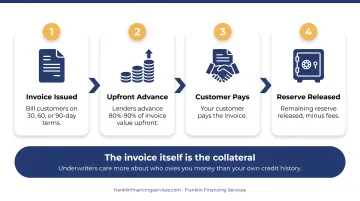
If your business bills other companies on 30, 60, or 90-day terms, invoice financing turns those unpaid invoices into working capital now. Lenders typically advance 80%-90% of invoice value upfront, then release the remaining reserve, minus fees, once your customer pays.
Documentation is minimal because the invoice itself is the collateral. This makes it a strong fit for B2B businesses with creditworthy clients but a thin conventional loan file, since underwriters care more about who owes you money than your own credit history.
Qualification Requirements for No-Doc Business Loans
No-doc doesn't mean no standards. Lenders still evaluate risk, they just use different inputs. Here's what typically matters:
| Factor | What Lenders Check |
|---|---|
| Time in business | Usually 6 months to 1 year minimum; longer history unlocks better terms |
| Monthly revenue | Product-specific floors; consistent deposits matter more than the total figure |
| Bank account health | NSF events, negative balances, average daily balance trends |
| Business structure | Registered legal entity and active EIN signal legitimacy |
| Personal credit | Often soft-pulled only; approvals possible well below bank thresholds |
| Industry type | Most mainstream sectors qualify; a handful of higher-risk industries face limits |
Time in Business: Six months is the common floor for products like merchant cash advances. Longer operating history generally means larger advances and lower pricing.
Monthly Revenue: An MCA might require $8,000 or more in monthly card sales, while an unsecured working capital loan may set its floor differently since it isn't tied to card processing volume. Either way, lenders care less about your total revenue and more about whether deposits show up reliably, week after week.
Bank Account Health: This is where the real underwriting happens. Frequent overdrafts or a pattern of negative balances signal risk, even if total revenue looks fine on paper.
Personal Credit: Many no-doc lenders weight this lightly. Scores in the 500s can still get approved, particularly for merchant cash advances, because the underwriting focus shifts to business cash flow instead.
Industry Type: Restaurants, retail, healthcare, construction, and most service businesses qualify without issue. A short list of higher-risk sectors (think adult entertainment, gambling, or businesses without consistent card or bank activity) faces more limited options across the industry.
No-Doc Loans vs. Traditional Financing: Costs, Speed, and Terms
The paperwork difference is obvious. The cost and speed difference is where the real decision happens.
| Attribute | Bank / SBA Loans | No-Doc / Online Financing |
|---|---|---|
| Documentation | Tax returns, financial statements, business plan | Bank statements plus basic business info |
| Approval speed | Weeks to several months | Same-day to a few business days |
| Rate range | 6.37%-10.98% for bank loans (as of mid-2025) | 14%-99% for online products; merchant cash advances (MCAs) can run higher |
| Repayment | Monthly | Often daily or weekly |
| Collateral | Frequently required | Usually none, but personal guarantees may still apply |
Rates like these come from NerdWallet's benchmark data on average business loan rates. The gap exists because no-doc lenders are absorbing more risk with less information, and they price accordingly.
Factor rates aren't the same as APR. A 1.2 factor rate on a $50,000 advance means $60,000 in total repayment. It does not mean a 20% annual rate. If that advance repays over 9 months through daily withdrawals, the effective APR runs considerably higher once you annualize the cost, because you're paying a fixed fee over a compressed timeline.
Here's a rough way to think about it: on a $50,000 loan with fixed weekly payments over 12 months at a factor rate of 1.25, you'd repay $62,500 total, roughly $1,200 per week. Compare that structure against a bank term loan spreading similar principal over 5 years at single-digit interest, and the monthly cash outlay looks completely different.
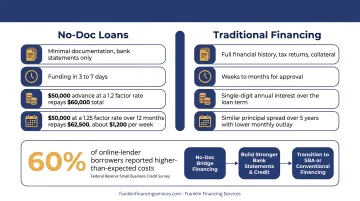
60% of online-lender borrowers reported higher-than-expected costs in the Federal Reserve's Small Business Credit Survey. That's a strong argument for getting multiple quotes before signing anything.
Most business owners don't use no-doc financing forever. It works best as a bridge: solve the immediate cash need now, build stronger bank statements and credit over the next year, then transition into SBA or conventional financing once you qualify for better terms.
How Franklin Financing Services Helps You Get Funded
Getting turned down by one bank doesn't mean you're out of options. It usually means you approached the wrong lender. Franklin Financing Services works as a financing partner with access to multiple national lending partners, matching business owners with the product that actually fits their situation.
A few things worth knowing:
- SBA Preferred designation. Franklin Financing Services is designated as a Preferred Financial Services company by SBA lenders, which supports faster processing and access to a broader range of solutions than any single bank can offer.
- Speed that matches the need. Programs like the Easy Pay Cash Advance and the FAST TRACK business term loan deliver approvals in 24-48 hours, with funding in as little as 3-7 days for qualifying businesses.
- Documentation kept light. The Easy Pay Cash Advance skips financials, tax returns, and asset documentation. Just six months of credit card statements determine your advance, calculated at 80%-120% of average monthly receipts, up to $150,000.
- Repayment tied to revenue. Instead of a rigid monthly bill, repayment flexes with your credit card receipts or revenue, so slower periods don't create the same strain a fixed payment would.
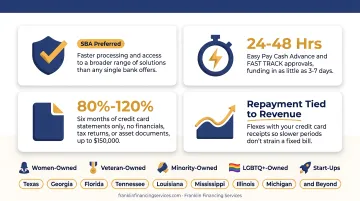
Franklin Financing Services also serves industries and business owners that traditional banks often overlook, including women-owned, veteran-owned, minority-owned, LGBTQ+-owned, and start-up businesses. Service areas span Texas, Georgia, Florida, Tennessee, Louisiana, Mississippi, Illinois, Michigan, and beyond.
Whether you've been turned down for poor credit, late payments, or limited documentation, a free financing evaluation can identify which program fits your revenue pattern and timeline.
Frequently Asked Questions
What is a no-doc business line of credit?
It's a revolving credit facility approved with minimal documentation, typically bank statements and basic business details. You draw funds as needed and pay interest only on the amount used.
What are the eligibility requirements for a no-doc business line of credit?
Most lenders want several months to a year in business, consistent monthly revenue, healthy bank statement activity, and a modest personal credit score. Exact thresholds vary by lender.
What is the monthly payment on a $50,000 business loan?
It depends heavily on term length, factor rate or interest rate, and repayment structure. As shown earlier, a $50,000 advance at a 1.25 factor rate repaid weekly over a year runs roughly $1,200 per week.
Is a no-doc business loan the same as a stated income loan?
No. Old stated-income loans relied on self-reported figures with little verification. Modern no-doc products verify revenue through actual bank statements, which is why "low-doc" or "bank-statement loan" is the more accurate term.
How fast can I get funded with a no-doc business loan?
Merchant cash advances can fund the same day. Unsecured working capital loans typically fund within 24-72 hours of approval, assuming your documents are ready upfront.
Can I get a no-doc business loan with bad personal credit?
Often, yes. Many no-doc lenders weight personal credit lightly and focus primarily on business revenue and bank statement health, making approval possible even with scores in the 500s.