A business cash flow loan solves this by lending against your projected revenue instead of physical assets like real estate or equipment. This article breaks down how these loans work, the main types available, qualification requirements, and how they compare to asset-based alternatives.
Many businesses turned down by traditional banks over credit history or lack of collateral find cash flow-based financing offers a faster, more flexible path forward.
Key Takeaways
- Cash flow loans use revenue projections as collateral, not physical assets
- Approvals often take just 24-48 hours, with funding in days, not weeks
- Four common structures exist: term loans, credit lines, invoice financing, and merchant cash advances
- Weak credit won't disqualify you if revenue and bank activity are strong
- Brokers with multiple national lender relationships expand your options beyond one bank's criteria
What Is a Business Cash Flow Loan?
A business cash flow loan is financing extended based on a company's historical and projected cash inflows rather than collateral. Lenders look at what your business earns and expect to keep earning, then structure repayment around that revenue cycle.
This category goes by a few names: cash flow financing or cash flow lending. Don't confuse it with cash flow from financing activities—an accounting term describing how equity and debt changes appear on a financial statement. If you're applying for capital, you want the lending definition, not the accounting one.
With that distinction in mind, who benefits most? Asset-light businesses with strong revenue but few hard assets to pledge:
- Service providers (consultants, agencies, contractors)
- Restaurants and food service operations
- Retailers with steady card sales
- Healthcare practices and professional firms
The Shift Toward Alternative Lenders
Traditional banks aren't always equipped to serve these businesses, which is part of why alternative financing has grown so quickly. According to the 2026 Report on Employer Firms from the Federal Reserve, the share of small business financing applicants using online fintech lenders rose sharply. That figure climbed from 17% in 2020 to 29% in the most recent survey.
Unlike single-bank lending, working with a financing partner that maintains relationships across multiple national lenders means you can compare several cash-flow-based options at once. Franklin Financing Services, for example, structures this kind of comparison shopping into its process rather than sending every client through one institution's rigid criteria.
How Does a Business Cash Flow Loan Work?
Instead of requesting collateral documentation, lenders review your bank statements, revenue trends, and accounts receivable/payable patterns. The underwriting question shifts from "what can we repossess?" to "can this business generate enough cash to repay us?"
Most lenders request a similar core set of documents. This is a common industry norm per Nav's lender marketplace guidance, though exact requirements vary by lender:
- 3-6 months of business bank statements
- Time in business
- Average monthly revenue
- Entity type and basic business details
Franklin Financing Services' FAST TRACK business term loan program, for instance, asks for just the last four months of bank statements alongside a completed application—a leaner requirement than many traditional loan applications.
Repayment Structures Vary by Product
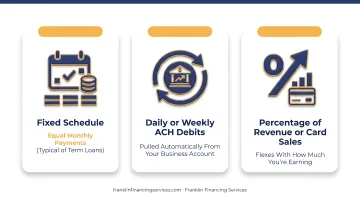
Repayment isn't one-size-fits-all. Depending on the loan type, you might see:
- A fixed schedule with equal monthly payments (typical of term loans)
- Daily or weekly ACH debits pulled automatically from your business account
- A percentage of revenue or card sales, which flexes with how much you're earning
Speed Is the Defining Feature
Approval speed sets this category apart from traditional secured lending. Many programs render decisions in 24-48 hours and fund within days rather than the weeks a bank might take to appraise collateral and finalize paperwork. Franklin's Easy Pay Cash Advance, for example, offers approvals within 48 hours and funding in under seven days.
Speed isn't the only advantage some programs offer. Certain cash flow financing options also skip the personal guarantee requirement entirely. Easy Pay is one such product, differentiating it from many traditional or asset-backed loan agreements where a guarantee is standard.
Types of Business Cash Flow Loans
"Cash flow loan" is really an umbrella term. Several distinct products fall under it, each suited to different timing gaps.
Term Loans
A term loan provides a lump sum upfront, repaid on a fixed schedule. It's useful for one-time needs like a bulk inventory purchase or bridging a single payroll gap. Franklin's Business Term Loan program offers $20,000 to $500,000 with repayment terms of one to four years, while its FAST TRACK version narrows to $20,000-$100,000 with approval in 24-48 hours.
Business Lines of Credit
A line of credit is revolving. You draw what you need, repay it, and can draw again—paying interest only on the amount used. This structure works well for recurring or seasonal cash gaps, such as a retailer building inventory before a holiday rush.
Invoice Financing
Invoice financing advances a percentage of your outstanding invoices, with repayment settled once your client pays. It's a strong fit for B2B businesses with slow-paying customers who might otherwise wait 30, 60, or 90 days to collect.
Merchant Cash Advances
A merchant cash advance (MCA) provides upfront cash in exchange for a percentage of future daily card sales. Cost is measured by a factor rate rather than a traditional interest rate. The CFPB notes that MCAs are often structured as a purchase of future revenue rather than a conventional loan.
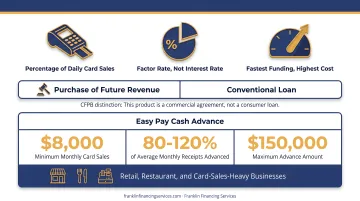
This is usually the fastest but most expensive option, and it's tailored well to retail, restaurant, and other card-sales-heavy businesses. Franklin's Easy Pay Cash Advance requires a minimum of $8,000 in monthly card sales and advances 80-120% of average monthly receipts, up to $150,000.
| Product | Best For | Repayment Basis | Typical Speed |
|---|---|---|---|
| Term Loan | One-time expenses | Fixed monthly payments | Days |
| Line of Credit | Seasonal/recurring gaps | Interest on amount drawn | Days once approved |
| Invoice Financing | B2B, slow-paying clients | Settled at invoice collection | Days |
| Merchant Cash Advance | Card-sales-heavy businesses | % of daily card sales | Fastest, often 48 hrs |
Cash Flow Loans vs. Asset-Based Loans
The core distinction comes down to what backs the loan: asset-based loans require collateral (equipment, real estate, inventory) that the lender can seize on default, while cash flow loans rely on projected revenue performance instead.
This makes the two products suited to different kinds of businesses:
- Asset-based loans fit capital-heavy businesses like manufacturers, distributors, or companies with significant equipment or inventory value
- Cash flow loans fit service-based or asset-light businesses with strong sales but few physical assets to pledge
The table below breaks down the practical differences lenders and borrowers should expect:
| Factor | Cash Flow Loan | Asset-Based Loan |
|---|---|---|
| Collateral required | No (or minimal) | Yes: equipment, real estate, inventory |
| Approval speed | Often 24-48 hours | Weeks (requires appraisal) |
| Primary underwriting factor | Revenue and bank activity | Collateral value |
| Best fit | Service, retail, restaurants | Manufacturers, distributors |
Qualification speed and criteria differ, too: cash flow loans often approve faster because lenders weigh recent revenue and bank activity heavily, while asset-based loans require more extensive documentation and a formal appraisal of collateral value before funding can move forward.
Benefits and Risks of Cash Flow Loans
Like any financing tool, cash flow loans come with real advantages and real trade-offs. Weigh both before signing.
Key Benefits
- No collateral required, making the loan accessible to businesses without significant fixed assets
- Approval is possible even with imperfect credit if revenue and bank activity are strong, opening the door for businesses previously turned down by banks
- Flexible repayment structures tied to revenue or card receipts, which can ease pressure during slower periods depending on the product
- Faster funding timelines than many traditional bank loans, with approval possible in 24-48 hours and funding in as little as 3-7 days
Franklin's Revenue-Based Financing, for instance, structures repayment as 3-9% of monthly receipts rather than a fixed payment, so a slower month means a smaller payment automatically.
Key Risks
- Higher costs. Because these loans are unsecured or less secured, they often carry higher interest rates or factor-rate costs compared to traditional secured loans.
- Short repayment windows. Terms often run from a few months to a few years, meaning this financing suits short-term gaps, not long-term capital projects.
- Cash strain from automatic debits. Daily or weekly ACH repayment can strain a business with inconsistent cash flow, so map repayments against expected deposits before signing anything.
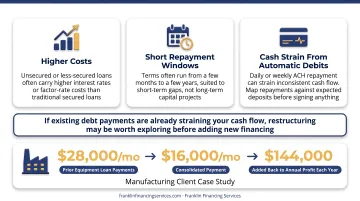
If existing debt payments are already straining your cash flow, restructuring may be worth exploring before adding new financing. One manufacturing client consolidated equipment loan payments of $28,000 a month into a single $16,000 monthly payment, adding $144,000 back to annual profit each year.
How to Qualify for a Business Cash Flow Loan
Lenders in this category typically assess a narrower, more revenue-focused set of factors than traditional banks:
- Time in business: often as little as 6 months for some products, though Franklin's Revenue-Based Financing typically looks for 12-18 months
- Consistent monthly revenue: lenders want to see stable or growing trends, not wild swings
- 3-6 months of clean bank statements: few overdrafts, consistent deposit patterns
Credit score requirements are typically more flexible than traditional bank loans, though weaker credit may mean higher costs or a smaller approved amount.
Getting turned down by a single bank doesn't mean you're out of options. Working with a financing partner with relationships across multiple national lenders, such as Franklin Financing Services, can help you identify a cash flow-based solution even after a bank turndown, often with approvals in 24-48 hours and funding in as little as 3-7 days.
For larger financing needs, Franklin's SBA Preferred designation delivers faster SBA 7(a) loan processing along with structural advantages like no points and no balloon payments, on loans ranging from $150,000 to $5 million.
Frequently Asked Questions
What is cash flow financing?
Cash flow financing is a way to borrow against projected future revenue rather than physical assets. Businesses typically use it for working capital needs like payroll, rent, and inventory during timing gaps between expenses and collections.
What is the difference between cash flow financing and asset financing?
Cash flow financing is backed by projected revenue, while asset financing requires physical collateral like equipment or property. The right fit depends on whether your business has strong assets or strong recurring revenue.
How fast can a business get funded with a cash flow loan?
Many programs offer decisions in 24-48 hours and funding within 3-7 days, though timing varies by lender and product. This is much faster than the weeks typical of traditional bank loans.
Can I qualify for a cash flow loan with bad credit?
Many cash flow lenders weigh recent revenue and bank activity more heavily than credit score alone. Weaker credit may still mean higher costs or a reduced approved amount.
Is a merchant cash advance the same as a cash flow loan?
An MCA is one specific type of cash flow financing, repaid via a percentage of daily card sales using a factor rate. It's distinct from term loans or lines of credit, which use different repayment structures.
What documents are typically needed to apply for a cash flow loan?
Common requirements include 3-6 months of business bank statements, proof of revenue, basic business details like entity type and time in business, and sometimes a credit check depending on the lender.