Major brokerages, including Charles Schwab, Public (through Apex Clearing), and Fidelity, run a Fully Paid Securities Lending (FPSL) program that lets you loan out shares you already own outright. Your broker pays you a portion of the fee it collects from the borrower.
This guide breaks down how FPSL actually works, what kind of income you can realistically expect, the risks worth understanding, and how to enroll (or back out) if it's not for you.
Key Takeaways
- Earn income by lending your fully-owned shares to institutions or short sellers via your broker
- Payout structures vary by broker: Schwab splits income 50/50, while Public pays 10% of Apex's net proceeds
- Loaned shares are backed by cash or Treasury collateral but lose SIPC protection and voting rights
- You can opt out or sell your shares anytime — participation is entirely voluntary
What Is the Fully Paid Securities Lending Program?
A "fully paid" security is exactly what it sounds like: a stock or ETF you've paid for in full, with no margin debt attached. That full ownership is what makes your shares eligible for this program in the first place.
Here's how the arrangement is structured:
- A clearing firm or broker-dealer — such as Apex Clearing, Charles Schwab, or Fidelity — operates the program on behalf of enrolled clients
- Borrowers are typically hedge funds, market makers, or other institutional investors
- The purpose is usually to facilitate short sales, cover fails-to-deliver, or satisfy settlement obligations
This isn't some gray-market side deal. Securities lending is a well-established, heavily regulated practice, with oversight that varies by country:
- United States: Governed by SEC Exchange Act Rule 15c3-3 and FINRA Rule 4330, which require a written loan agreement and collateral that fully secures the loan
- Canada: Overseen by CIRO, which mandates client consent before any shares move
FPSL differs from the securities lending that already happens on margin accounts. If you buy stock with borrowed money, your broker can lend those shares without any special enrollment; that provision is already baked into the margin agreement you signed. FPSL, by contrast, applies to shares you own free and clear, and it requires you to actively opt in.
Not every broker offers this program, and even among those that do, enrollment isn't automatic. FINRA has sanctioned firms for enrolling customers without proper consent, which tells you regulators take the opt-in requirement seriously.
How Does Fully Paid Securities Lending Work?
Once you're enrolled, the mechanics run mostly on autopilot. Here's the basic lifecycle:
- You opt in by signing a lending agreement with your broker
- The broker identifies demand for your specific shares from institutional borrowers
- Shares get loaned and a fee begins accruing daily
- You get paid your share of that fee, typically once a month
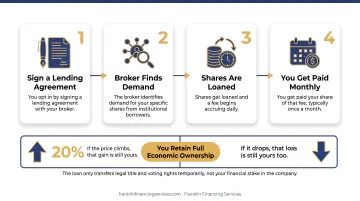
Throughout this process, you retain full economic ownership of the stock. If the price climbs 20% while your shares are on loan, that gain is still yours. If it drops, that loss is still yours too. The loan only transfers legal title and voting rights temporarily — not your financial stake in the company.
Collateral Protects the Arrangement
Brokers don't just hand your shares to a borrower on a promise. They post collateral, held at a separate custodian, to secure the loan:
| Broker | Disclosed Collateral Level |
|---|---|
| Schwab | 102% (cash or Treasury bills/notes) |
| Fidelity | At least 100% (cash or cash-equivalent) |
| Public/Apex | At least 100% (cash or Treasuries) |
That collateral is marked-to-market daily, so if your loaned stock jumps in value, the collateral backing it adjusts along with it.
You're Never Locked In
You can sell your loaned shares whenever you want. The sale automatically terminates (or triggers a recall of) the loan, and settlement proceeds normally: no waiting period, no special paperwork on your end.
Some brokers handle the mechanics a bit differently behind the scenes. Schwab, for instance, moves loaned positions into a supplemental account that mirrors your original holdings until the loan wraps up, then transfers everything back.
How Much Can You Earn From FPSL?
Here's where expectations need a reality check: your income depends entirely on the revenue-share model your broker uses, and those models aren't uniform:
- Schwab generally splits lending income 50/50 with the client
- Public pays customers 10% of Apex's total net lending proceeds
- Fidelity doesn't publish a fixed split — it quotes a variable customer lending rate instead
What actually drives the rate itself boils down to supply and demand. Stocks that are hard to borrow, heavily shorted, or unusually volatile tend to command higher lending fees. A boring, widely-held blue chip might earn you almost nothing, while a small-cap stock everyone's betting against could earn considerably more.
Schwab's own illustrative example puts this in perspective:
| Loaned Share Value | Annualized Rate | Gross Monthly Fee | Investor's Cut (50/50 split) |
|---|---|---|---|
| $50,000 | 10.5% | $437.50 | $218.75 |
That's a helpful benchmark, but treat it as an example, not a promise. Schwab itself notes that rates shift daily and a position can sit unloaned for weeks or even months with zero income to show for it.
Payouts typically land monthly, credited directly to your brokerage account (or, in Schwab's case, first to the supplemental account before transferring over).
Benefits and Risks of Fully Paid Securities Lending
Weighing this program comes down to a simple trade: potential income against a handful of specific, well-defined risks.
Key Benefits for Investors
- Passive income from shares that would otherwise just sit in your portfolio, at no added cost to you
- Full market exposure retained: gains and losses keep accruing normally on the underlying stock
- Hands-off process: the broker automates matching, collateral, and payouts
- Flexibility to opt out or exclude specific holdings anytime, without penalty
Key Risks to Understand
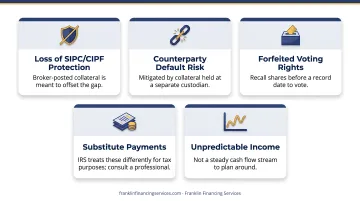
- Loss of SIPC/CIPF protection on loaned shares, though broker-posted collateral is meant to offset this gap
- Counterparty default risk if the broker fails to return your shares, mitigated by collateral held at a separate custodian
- Forfeited voting rights while shares remain on loan. You'd need to recall them before a record date to vote
- Substitute payments instead of dividends, which the IRS treats differently for federal tax purposes — consult a tax professional for specifics
- Unpredictable income: this isn't a steady cash flow stream you can plan around
Eligibility, Enrollment, and Opting Out
Not every account or every share qualifies. Common requirements include:
- Minimum account balance: often around $25,000 to $100,000, depending on the broker
- Whole-share ownership only: fractional shares generally don't qualify
- Retirement account exclusions: Schwab, for example, excludes employer-sponsored 401(k) plans under ERISA rules
Enrollment itself is straightforward. Most brokers require you to review and digitally sign a lending agreement or disclosure document before any shares can be loaned out. Once you're in, you can typically monitor loaned positions through account statements or a dedicated dashboard, and opt out anytime by contacting your broker directly.
FPSL is designed for individual investors monetizing a personal stock portfolio, not for business financing. Business owners seeking working capital, equipment funding, or debt consolidation need an entirely different type of financing partner.
That's where a firm like Franklin Financing Services fits in, offering small and medium-sized businesses financing options such as:
- SBA 7(a) loans ranging from $150,000 to $5 million for equipment, working capital, or expansion
- Business term loans from $20,000 to $500,000, with funding available in as little as 3 days
- Debt restructuring that consolidated one manufacturing client's equipment loans, cutting monthly payments from $28,000 to $16,000 and adding $144,000 back to annual profits
FPSL supplements passive income from your portfolio; Franklin Financing Services helps fund active business growth.
Frequently Asked Questions
What is fully paid securities lending?
It's a program where you loan out shares you own outright (not on margin) to your broker in exchange for a share of the lending fee. You keep full ownership and market exposure the entire time.
How much do you make from FPSL?
It depends on your broker's fee-share percentage, the specific stock's lending rate, and market demand. Earnings can range from a few dollars a month to much more for hard-to-borrow shares.
Is fully paid securities lending safe?
Broker-posted collateral protects against counterparty default, but loaned shares lose SIPC coverage. Your comfort level should factor in both the collateral structure and your broker's overall credibility.
Can I sell my shares while they're on loan?
Yes. Selling automatically terminates the loan, and your sale settles normally without any extra steps or delays on your end.
Do I lose my dividends if my shares are on loan?
You'll receive a "substitute payment" instead of the actual dividend. These payments are often taxed differently than qualified dividends, so check with a tax advisor.
Which brokers offer fully paid securities lending?
Several major U.S. brokerages offer FPSL, including Charles Schwab, Fidelity, and Public (through Apex Clearing). Eligibility, minimums, and payout structures vary by firm.