Introduction
A new rooftop unit costs thousands more than it did two years ago. Diesel prices swing your fuel budget every quarter. And the gap between a slow spring and a scorching July can strain payroll before the first heat wave even hits.
For HVAC contractors heading into 2026, outside capital has become essential for growth. It helps you compete for bigger commercial jobs and keep crews staffed year-round.
Here's the frustrating part: many HVAC business owners get turned down by traditional banks, even when the fundamentals are solid. Seasonal revenue patterns, a shorter time in business, or a credit score that doesn't fit a bank's narrow box can all trigger a decline.
This guide breaks down the types of HVAC business loans available in 2026, what they actually cost, and how to qualify. It also shows how a financing partner like Franklin Financing Services helps contractors get funded even after a bank says no.
Key Takeaways
- HVAC financing spans equipment loans, working capital, lines of credit, SBA loans, and revenue-based advances for different financing needs.
- The U.S. heating and air-conditioning contractor industry is projected to reach $159.4 billion in 2026 revenue, per IBISWorld, making capital access essential.
- Alternative lenders can approve HVAC contractors in 24-48 hours and fund within 3-7 days, even after a bank turndown.
- Comparing total cost of capital, not just the monthly payment, is the biggest factor in choosing the right loan.
What Is an HVAC Business Loan?
An HVAC business loan is financing designed for heating, ventilation, and air conditioning companies. It funds equipment and vehicles, covers payroll, or fuels growth, such as opening a new service territory or acquiring a competitor.
These loans function much like general small business loans, but underwriting looks a little different. Lenders factor in:
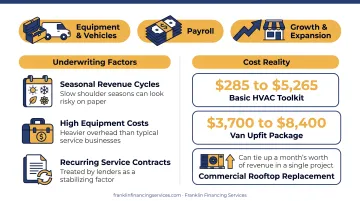
- Seasonal revenue cycles, including the slow shoulder seasons between summer and winter peaks
- High equipment costs relative to typical service-business overhead
- Recurring service contract income, which many lenders treat as a stabilizing factor
That last point matters. HVAC businesses can look risky on paper during off-months, even when they're profitable year-round. That risk perception is exactly why so much capital often sits tied up in tools and vehicles.
The cost reality: financing isn't reserved for struggling contractors. A basic HVAC toolkit alone runs $285 to $5,265, according to a 2026 Jobber estimate, and that's before adding a van, upfit racking, diagnostic tools, or parts inventory.
Van upfit packages alone commonly run $3,700 to $8,400, and one commercial rooftop unit for a replacement job can tie up a month's worth of revenue in a single project.
That's why even well-run, profitable HVAC companies use financing routinely, not as a last resort.
Types of HVAC Business Loans in 2026
The right loan type depends on what the money is for and how fast you need it. Here's how the main options stack up for HVAC contractors.
Equipment & Vehicle Financing
When you need a new rooftop unit, diagnostic tools, or a service van, equipment financing uses the asset itself as collateral. Lenders typically finance 80-100% of the asset's value, with repayment terms structured around how long that equipment will realistically last.
Why it works for HVAC contractors:
- Preserves working capital for payroll and fuel
- Leans approval more on equipment value than your credit history
- Runs terms 2-7 years, matched to the asset's useful life
This is generally the fastest path to funding a specific purchase, since the lender's risk is tied to something they can repossess.
Working Capital Loans
Working capital loans provide unrestricted cash for payroll, fuel, supplies, or marketing. Most are unsecured, meaning no collateral is required.
HVAC contractors commonly use this financing to bridge the gap between summer and winter peaks, when revenue slows but fixed costs like payroll and insurance don't.
Franklin Financing Services structures this through Business Term Loans, with amounts from $20,000 to $500,000 and repayment terms up to four years. A FAST TRACK version can approve loans up to $100,000 in 24-48 hours with just four months of bank statements.
Business Lines of Credit
A line of credit works differently than a term loan. You draw funds as needed, up to a set limit, and pay interest only on what you actually use.
This structure suits contractors managing:
- Seasonal demand swings between spring tune-ups and summer emergency calls
- Unexpected repairs to trucks or diagnostic equipment
- Parts inventory purchases ahead of a busy season
Once you repay what's drawn, the credit becomes available again, making it a flexible cushion rather than a one-time infusion.
SBA Loans
SBA 7(a) and 504 loans offer the lowest rates and longest repayment terms of any small business financing option, which makes them well-suited for major investments like a company acquisition, a new facility, or a large equipment package.
The SBA 7(a) program supports loans up to $5 million, with terms generally running up to 10 years for equipment or working capital and 25 years for real estate. Franklin Financing Services offers SBA 7(a) loans from $150,000 to $5 million, with no balloon payments and no points.
As a company designated a Preferred Financial Services provider by SBA lenders, Franklin Financing Services can move applications through underwriting faster than many non-preferred lenders. That matters most when you need certainty on timing, since SBA loans typically close slower than alternative financing.
Merchant Cash Advances & Revenue-Based Financing
Merchant cash advances (MCAs) and revenue-based financing repay themselves as a percentage of your daily or weekly revenue rather than a fixed monthly payment. This suits contractors with imperfect credit who need capital fast and want payments that flex with cash flow.
Franklin Financing Services' Easy Pay Cash Advance, for example, advances 80-120% of your average monthly credit card receipts (up to $150,000), then collects 15-20% of future credit card sales until it's repaid. No personal guarantee, financials, or tax returns are required.
For larger, longer-term needs, Revenue-Based Financing offers $50,000 to $1 million over 2-5 years, with repayment set at 3-9% of monthly cash receipts. This option works well for qualifying women-owned, veteran-owned, and other underserved HVAC businesses meeting the $1 million annual revenue threshold.
Equipment Loan Consolidation & Refinancing
Contractors juggling several equipment loans, each with a different rate, term, and due date, often bleed cash to monthly payments that no longer make sense.
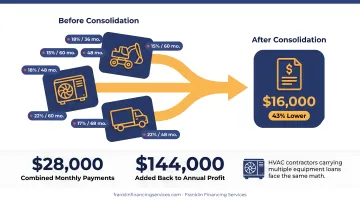
Debt restructuring consolidates multiple equipment loans into one refinanced loan, often lowering monthly payments significantly for qualifying businesses. Consider a similar equipment-heavy case: a manufacturing client restructured $28,000 in combined monthly equipment payments down to $16,000, a 43% reduction that added $144,000 back to annual profit. HVAC contractors carrying multiple equipment loans face the same math.
If equipment debt is eating into the margin on every job, refinancing is worth evaluating before taking on new debt.
Loan Amounts, Costs & Monthly Payments: What to Expect
The monthly payment on a $50,000 loan changes dramatically based on rate and term. Here's a simplified example using standard amortization math:
| Term | 10% APR | 25% APR | 45% APR |
|---|---|---|---|
| 24 months | $2,308/mo | $2,667/mo | $3,196/mo |
| 36 months | $1,614/mo | $1,988/mo | $2,555/mo |
| 60 months | $1,062/mo | $1,468/mo | $2,107/mo |
Estimates based on standard amortization; actual offers vary by lender and creditworthiness.
Notice how a 45% APR nearly doubles the payment versus 10% APR at 60 months, and adds real cost at every term length. That's why total cost of capital matters more than the payment alone. Look at:
- The full APR, not just a verbally quoted "rate"
- Origination and packaging fees
- Prepayment penalties
- Whether fees are financed into the loan or charged upfront
Published benchmarks show how wide these ranges get. Equipment financing runs roughly 4%-45% APR, online working capital term loans run approximately 14%-99% APR, and merchant cash advances typically use factor rates between 1.04 and 1.32 rather than a stated APR. A factor rate isn't directly comparable to APR, since it reflects total repayment on the advance rather than an annualized cost.
This is exactly where borrowers get burned. The Federal Reserve's 2026 Small Business Credit Survey found that 60% of online-lender borrowers said their actual borrowing costs came in higher than expected, compared with just 32% at large banks. Read the total repayment figure, not just the headline rate.
Comparing Loan Types at a Glance
| Loan Type | Typical Amount | Funding Speed | Rate Range |
|---|---|---|---|
| Equipment Financing | $20K-$500K+ | 3-7 days | ~4%-45% APR |
| Working Capital Loan | $20K-$500K | 24-48 hrs approval | ~14%-99% APR (online) |
| Line of Credit | Varies by lender | Days | ~10%-99% APR |
| SBA 7(a) | $150K-$5M | 30-90 days | Bank-negotiated, SBA-capped |
| MCA / Revenue-Based | $50K-$1M | 48 hrs approval, <7 days funding | Factor rate 1.04-1.32, or 3-9% of receipts |
What About Down Payments?
Deposit requirements vary by product. Equipment financing and SBA loans may require 0-20% down, depending on collateral strength and lender, while working capital loans and lines of credit often require no deposit at all.
Franklin Financing Services structures some programs, like Easy Pay Cash Advance and Revenue-Based Financing, around a percentage of revenue or credit card receipts rather than rigid fixed amortization. That flexibility can lower the effective barrier to qualifying, since approval leans on cash flow rather than a large upfront deposit.
How to Qualify and Apply for HVAC Business Loans
Qualification Requirements
Lenders evaluate three main factors: time in business, revenue and cash flow, and credit score.
Time in Business: Most banks want at least two years of operating history. Alternative lenders are more flexible:
- Some approve businesses as young as 6 months
- Startups can often still access equipment-backed financing, since the asset secures the loan
- Franklin Financing Services' Easy Pay Cash Advance generally requires around one year in business, though exceptions exist
Revenue and Cash Flow: Lenders want proof your business generates enough cash to cover a new payment. Expect:
- Minimum monthly revenue thresholds that vary widely by product and lender
- 3-6 months of consistent bank deposits, which strengthens any application
- For revenue-based financing, steady or growing monthly receipts matter more than one strong month
Credit Score Tiers: Your credit score opens or closes doors:
- 680+: Access to the most products at the best rates, including SBA loans
- 580-680: Still qualifies for many alternative products, typically at higher rates
- Below 580: Can work with strong, consistent revenue, especially when working with financing partners like Franklin Financing Services, who specialize in finding solutions despite poor credit, late payments, or prior bank turndowns
Documentation and Application Process
With qualification factors clear, gathering documentation and moving through the application is straightforward.
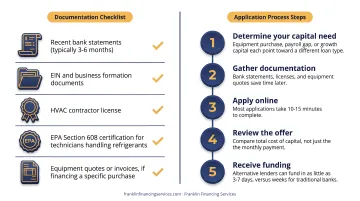
Documentation Checklist: Have these ready before you apply:
- Recent bank statements (typically 3-6 months)
- EIN and business formation documents
- HVAC contractor license
- EPA Section 608 certification for technicians handling refrigerants
- Equipment quotes or invoices, if financing a specific purchase
Application Process Steps: Getting funded generally follows five steps:
- Determine your capital need - equipment purchase, payroll gap, or growth capital each point toward a different loan type.
- Gather documentation - bank statements, licenses, and equipment quotes save time later.
- Apply online - most applications take 10-15 minutes to complete.
- Review the offer - compare total cost of capital, not just the monthly payment.
- Receive funding - alternative lenders can fund in as little as 3-7 days, versus weeks for traditional banks.
How Franklin Financing Services Helps HVAC Contractors
Franklin Financing Services works as a financing partner with relationships across national lenders. The team matches HVAC contractors with the right product, especially when a bank has already said no.
Key benefits for HVAC contractors include:
- Fast approvals: 24-48 hours for programs like FAST TRACK Business Term Loans and Easy Pay Cash Advance
- Quick funding: as little as 3-7 days from approval to cash in your account
- No personal guarantee required on select programs, including Easy Pay Cash Advance
- Flexible repayment structures based on revenue or credit card receipts, rather than rigid fixed amortization
Franklin Financing Services also holds a Preferred Financial Services designation from SBA lenders, which helps move SBA 7(a) applications through underwriting more efficiently than many non-preferred lenders manage.
The company's certified financial professionals work across 16+ product categories, from equipment leasing to debt restructuring. This range means contractors aren't forced into one loan type that doesn't fit their business.
If a bank turndown, seasonal revenue, or credit challenges have stalled your search, request a free evaluation to see which program fits your business.
Frequently Asked Questions
What is an HVAC loan?
An HVAC business loan is financing designed for heating, ventilation, and air conditioning companies. It covers equipment, vehicles, payroll, and growth costs like acquisitions or new service territories.
What is the monthly payment on a $50,000 business loan?
It depends on your rate and term. Using the example table above, a 36-month loan runs roughly $1,614 to $2,555 per month depending on APR. Get a personalized quote for exact numbers.
How much deposit do you need for a business loan?
Many working capital loans and lines of credit require no deposit at all. Equipment financing and SBA loans may require 0-20% down, depending on collateral and lender.
What credit score do I need to qualify for an HVAC business loan?
A 680+ score opens the most products at the best rates, while 580-680 still qualifies for many alternative products. Even lower scores can work if your revenue is strong and consistent.
Can I get an HVAC business loan with bad credit or after a bank turndown?
Yes. Franklin Financing Services connects HVAC contractors with alternative lenders who fund businesses that banks decline, often weighing cash flow and revenue more heavily than credit score alone.
How fast can I get funded for HVAC equipment or working capital?
Alternative lenders can approve applications in 24-48 hours and fund in as little as 3-7 days. Traditional banks and SBA loans typically take several weeks longer.