That combination, rising overhead and a plateauing market, puts pressure on owners to find funding fast. Many get turned down by traditional banks anyway, whether it's a thin credit file, less than two years in business, or cash flow that dips with the seasons.
This guide breaks down the loan types available in 2026, how much capital you actually need, who qualifies, and how to choose a financing partner that won't leave you stuck after a bank says no.
Key Takeaways
- Salons can access funding beyond banks, including SBA loans, equipment financing, and lines of credit
- A clear financial plan boosts approval odds, since startup costs vary widely by salon type and location
- Credit score and time in business matter, but bad credit and startups still have viable paths
- The right lender matters just as much as the right loan product
What Is a Beauty Salon Loan?
A beauty salon loan is business financing, either a lump sum or a revolving line of credit, used for salon-specific needs like new equipment, renovations, staffing, or day-to-day working capital.
No lender sells a product literally called a "salon loan." Instead, salon owners tap into general small business financing tools and match them to their goals:
- Buying chairs, dryers, or washing stations: equipment financing or a term loan
- Renovating a leased space: a term loan or SBA 7(a) loan
- Covering payroll during a slow month: a line of credit or revenue-based advance
- Opening a second location: SBA financing or a larger term loan
This flexibility cuts both ways. A brand-new salon booking its first chair and an established owner opening location number three both use financing, but the products that fit each situation look very different.
Types of Beauty Salon Loans to Consider in 2026
Here's a rundown of the main categories, ordered roughly from lowest-cost, slowest-funding options to faster, more expensive ones.
SBA Loans for Salons
The SBA 7(a) loan is the government-backed workhorse for small business financing. As of 2026, the maximum loan amount is $5 million, according to the SBA's own program page, making it suitable for real estate purchases, major buildouts, or multi-location expansions.
Rates are capped, not fixed. The SBA sets maximum spreads over a base rate, and for loans over $350,000, that cap is base rate plus 3 percentage points. Smaller loans carry higher caps.
For salons needing less, the SBA microloan program offers up to $50,000, with an average loan size closer to $13,000 and interest rates typically running 8% to 13%. Microloans work well for equipment, supplies, and fixtures, but not real estate or debt refinancing.
Both programs require a personal guarantee from anyone owning 20% or more of the business.
Term Loans & Equipment Financing
A term loan gives you a lump sum for a large, one-time expense—think a full salon renovation—and you repay it on a fixed schedule.
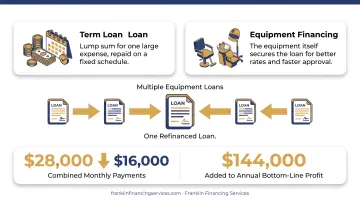
Equipment financing works differently. The equipment itself, whether that's styling chairs, shampoo bowls, or hooded dryers, secures the loan. That collateral often means better rates and faster approvals than an unsecured loan.
One detail owners overlook: existing equipment debt can often be restructured. Franklin Financing Services consolidates multiple equipment loans, sometimes with mismatched maturities, into one refinanced loan.
In one documented case, this approach cut a client's combined monthly payments from $28,000 to $16,000, adding $144,000 to annual bottom-line profit. Results vary by industry and equity position, but salons carrying multiple equipment notes can use the same strategy.
Business Lines of Credit
A line of credit is revolving. Draw what you need, repay it, and borrow again, paying interest only on the amount you've actually used.
For salons, this fits seasonal cash flow gaps almost perfectly:
- Cover payroll during a slow January without taking on a full term loan
- Restock inventory ahead of a busy wedding season
- Bridge the gap between a slow month and next month's bookings
Because you're not paying interest on unused credit, a line functions more like a safety net than a one-time capital injection.
Merchant Cash Advances & Revenue-Based Financing
A merchant cash advance (MCA) isn't technically a loan. It's an advance against future credit card sales, repaid automatically as a percentage of daily or weekly card transactions. When sales dip, repayment slows down too.
Here's the catch: factor rates are not the same as APR, and they can be far more expensive than they first appear. A Federal Reserve analysis published in March 2025 found that one advertised 1.15 factor rate worked out to an estimated APR of roughly 70% once the true cost was calculated.
Always ask a lender to translate factor rates into an annualized figure before signing anything.
Revenue-based financing operates on a similar principle but with more structure, typically requiring higher annual revenue and offering lower repayment percentages (often 3% to 9% of monthly receipts) over a longer term of two to five years.
Alternative & Online Lending for Startups or Credit Challenges
Online and alternative lenders evaluate overall business health, not just a FICO score. That's a meaningful shift for:
- Newer salons without two years of tax returns
- Owners with a past bankruptcy or late payment on their credit file
- Businesses turned down by a bank for reasons unrelated to actual performance
These lenders lean on bank statements, credit card processing volume, and revenue trends instead. It's a faster underwriting process, though usually a costlier one than a bank loan.
How Much Financing Do You Actually Need? Startup Costs & Financial Planning
Before applying anywhere, you need a number. Lenders want to see that you've done the math, not just asked for "as much as possible."
Typical Startup Costs for a New Salon
Franchise disclosure data offers a useful benchmark. Great Clips' current investment range for U.S. franchisees runs from $187,800 to $419,900, covering the franchise fee, leasehold improvements, opening inventory, and several months of additional operating funds.
Independent salons often land at the lower end or below it, depending on:
- Whether you're leasing or buying the space
- How many chairs and stations you're outfitting
- Local licensing and permit costs
- Whether you're buying new or used equipment
Ongoing Monthly Expenses to Plan For
Lenders expect a realistic monthly budget, not just a startup number. Common line items include:
- Payroll and stylist commissions
- Product inventory (color, retail lines, backbar supplies)
- Rent and utilities
- Booking and point-of-sale software
- Marketing and local advertising
How to Write a Simple Financial Plan for Your Salon
A financial plan doesn't need to be a 40-page document. Lenders generally want four things:
- Sales projections broken out by service line (e.g., cuts, color, retail).
- An expense breakdown that clearly separates fixed costs from variable costs.
- Your calculated break-even point—the monthly revenue needed to cover all expenses.
- A 12-month cash flow forecast that shows fluctuations month-by-month, not just an annual total.
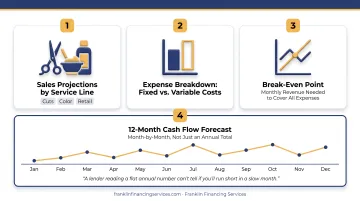
This last point matters most. A lender reading a flat annual number can't tell if you'll run short in a slow month.
Renovation & Expansion Budgeting
Adding a location or remodeling an existing space carries different costs than opening your first chair. Expect additional line items for design fees, permit re-filing, temporary closure revenue loss, and updated signage. Budget for a 10% to 15% contingency buffer; renovation projects rarely land exactly on estimate.
Who Qualifies & How to Choose the Right Lender
Qualification standards vary sharply depending on where you apply. Here's what lenders actually look at, and how to match your profile to the right partner.
Credit Score & Time-in-Business Requirements
| Lender type | Credit score benchmark | Time in business | Annual revenue |
|---|---|---|---|
| Bank of America (Business Advantage) | 700+ FICO typically | 2 years | $100,000+ |
| SBA 7(a) | No fixed minimum; must be "creditworthy" | Varies by lender | Varies by lender |
| OnDeck (online lender) | 625 FICO | 1 year | $100,000+ |
Banks sit at the strictest end. SBA loans have no universal published score, but individual lenders add their own layer of underwriting. Online lenders generally accept more risk in exchange for faster funding.
Revenue & Cash Flow Benchmarks
Beyond credit, lenders look at whether your revenue can actually support the debt. SBA guidelines require documented proof that cash flow, actual or projected, reasonably covers repayment. There's no single universal debt service coverage ratio; lenders build their own repayment analysis into the underwriting file. Named lenders like Bank of America and OnDeck both cite $100,000 in annual revenue as a practical floor for their standard products.
Financing for Women-Owned, Minority-Owned & Startup Salons
Yes, women can absolutely get funding to start or grow a business, and salons are one of the most common industries where this applies.
- The Amber Grant awards three $10,000 monthly grants plus three $50,000 year-end grants, totaling $510,000 annually, including a Startup Grant for idea-stage businesses with under $10,000 in sales.
- Revenue-based financing programs built for women-owned, veteran-owned, POC-owned, and LGBTQ+-owned businesses skip the traditional bank checklist, focusing instead on revenue trends and business health.
- SBA's Women-Owned Small Business certification helps with federal contracting eligibility, though it's not a direct funding source.
Startup salons without long credit histories still qualify for microloans, equipment financing, and alternative lending: options that weigh business potential over years on file.
Tips for Choosing the Right Financing Partner
Don't just compare rates. Compare:
- Total cost versus speed: a cheaper loan that takes eight weeks might cost you more in lost bookings than a faster, pricier option
- Flexibility during a rough patch: does the lender adjust payments if revenue dips, or is it a rigid fixed schedule regardless?
- Credit reporting: does the lender report to business credit bureaus, helping you build credit for future borrowing?
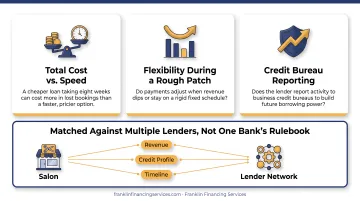
A financing intermediary like Franklin Financing Services works across all three criteria at once, matching a salon's revenue, credit profile, and timeline against lenders in its network rather than a single bank's rulebook.
Why Salon Owners Choose Franklin Financing Services
Franklin Financing Services doesn't sell one loan product and hope it fits. It works as a financing partner, matching salon owners to the right structure from a range of options after a bank has already said no or when credit history is uneven.
That matters because a bank turndown often has nothing to do with whether your salon is a good business. It's frequently about rigid criteria that don't account for seasonal revenue or a shorter time in business.
Franklin Financing Services holds an SBA Preferred Financial Services designation, enabling faster loan processing than many other SBA-affiliated lenders. Beyond SBA products, the firm offers:
- Approvals in 24-48 hours for qualifying programs like Business Term Loans FAST TRACK and Easy Pay Cash Advance
- Funding in as little as 3-7 days once approved
- Revenue-based repayment structures instead of rigid fixed schedules tied to bank-style criteria
The firm also works specifically with women-owned, veteran-owned, POC-owned, and startup businesses, segments that frequently get overlooked by conventional bank underwriting despite solid revenue and growth trends.
For a salon owner weighing an equipment upgrade, a renovation, or working capital to get through a slow season, that flexibility can be the difference between waiting months and getting funded within a week.
Frequently Asked Questions
What is a beauty loan?
A beauty loan is business financing used for salon needs like equipment, renovations, staffing, or working capital. The term simply describes the use case: lenders apply standard tools, such as term loans or equipment leases, to fit your salon's specific goal.
How do I write a financial plan for a salon?
Include sales projections broken out by service line, a full expense breakdown, your break-even point, and a 12-month cash flow forecast. Lenders want month-by-month detail, not just an annual estimate.
Can a woman get a loan to start a business?
Yes. Women-owned salons can access dedicated programs like the Amber Grant, plus revenue-based financing and alternative lenders that specifically serve women-owned and startup businesses without requiring a long credit history.
What is the minimum investment for a salon?
Franchise data shows a range from roughly $187,800 to $419,900 for a full-service franchise buildout, though independent salons often start lower. Costs vary heavily by location, lease terms, and service offerings.
How fast can I get approved for a beauty salon loan in 2026?
Alternative lenders and financing partners can approve certain programs in 24-48 hours, with funding in 3-7 days. SBA loans and traditional bank loans typically take several weeks.
Can I still get financing with bad credit or after a bank turndown?
Yes. Alternative lenders and financing partners often weigh business revenue, cash flow, and credit card processing volume more heavily than personal credit score, making funding possible even after a bank says no.