Many bar owners hit a wall when they approach traditional banks. Lenders often view nightlife and hospitality businesses as harder to underwrite, given cash-heavy operations and revenue that swings with the seasons. That leaves owners searching for other paths to funding.
This guide breaks down what bar financing actually is, the main funding types available, how lenders decide who qualifies, and how Franklin Financing Services helps bar owners get funded even after a bank says no.
Key Takeaways
- Bar financing includes SBA loans, term loans, equipment financing, and MCAs.
- Approval depends more on revenue, time in business, and cash flow than credit score.
- Franklin Financing Services can fund certain programs in just 24-48 hours.
- Consolidating multiple high-cost loans into one payment can lower monthly costs.
What Is Bar Financing?
Bar financing is business capital used by bar, tavern, and nightclub owners to open a new location, renovate an existing space, buy equipment, or cover cash flow gaps between busy and slow seasons. It's distinct from a personal loan in one key way: lenders underwrite it around the business itself.
That means monthly revenue, time in operation, and cash flow patterns carry more weight than an owner's personal income statement alone.
Why Banks Hesitate on Bar Loans
Banks often flag bars as harder deals for a few practical reasons:
- Licensing complexity — liquor licenses add regulatory steps banks aren't always equipped to evaluate quickly
- Cash-intensive operations — heavy cash handling requires more scrutiny during underwriting
- Revenue volatility — seasonal swings and weather-dependent traffic make income harder to predict
These factors don't guarantee automatic rejection. They do explain why conventional bank underwriting often fails to match how bars actually operate—a gap alternative lenders are built to fill. In practice, most bar owners end up working with lenders who evaluate deals using real revenue data instead of rigid credit-score cutoffs.
Four Core Purposes of Bar Financing
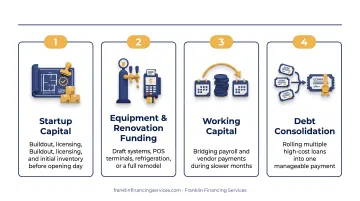
Most bar owners seek capital for one of four reasons:
- Startup capital — covering buildout, licensing fees, and initial inventory before opening day
- Equipment and renovation funding — draft systems, POS terminals, refrigeration, or a full remodel
- Working capital — bridging payroll and vendor payments during slower months
- Debt consolidation — rolling multiple high-cost loans into one manageable payment
Types of Bar Business Financing Options
Bar owners have more options than a single bank loan application. Here's how the main products break down.
SBA Loans
The SBA 7(a) loan is the most recognized government-backed option. The SBA guarantees a portion of the loan, which lowers the lender's risk and opens the door for businesses that might not qualify for a conventional bank loan.
Key structural details:
- Loan amounts up to $5 million, with SBA guaranteeing up to 85% of loans of $150,000 or less, and 75% above that threshold
- Repayment terms up to 25 years for real estate-related financing, generally 10 years or less for working capital and equipment
- SBA 7(a) terms allow funds to be used for real estate, working capital, equipment, and refinancing existing business debt
Franklin Financing Services carries a **Preferred Financial Services company by SBA lenders** designation, which speeds loan processing compared to non-preferred lenders. That speed matters when a licensing deadline or lease signing is on the clock.
Term Loans
A term loan delivers a lump sum upfront, repaid on a fixed schedule. It's the right fit for a one-time, defined expense: a full interior renovation, a second-location buildout, or a major equipment purchase.
Franklin's Business Term Loans run from $20,000 to $500,000, with repayment terms of 1 to 4 years at a fixed rate. Restaurants and bars are explicitly listed among the eligible industries for this program.
Business Line of Credit
A line of credit works differently from a term loan. Instead of a lump sum, a business draws only what it needs and pays interest solely on that amount, similar to a credit card. This revolving structure suits bars managing seasonal swings, payroll gaps between paydays, or an unexpected repair on a walk-in cooler.
For bars whose card sales fluctuate month to month, revenue-based options that scale repayment with actual receipts can serve a similar purpose. The business borrows against strong months without locking into a fixed payment during slow ones.
Equipment Financing
Refrigeration units, draft systems, and POS hardware can serve as their own collateral, which typically makes equipment financing easier to secure than unsecured capital. The equipment itself backs the loan.
Bars carrying multiple equipment loans at once often overpay. Franklin's debt restructuring programs can reduce combined monthly payments by 30% or more by consolidating separate loans into a single payment.
In one documented case, a business paying $28,000 a month across multiple loans restructured down to $16,000 a month. That 43% reduction freed up $144,000 in annual cash flow.
Merchant Cash Advances & Revenue-Based Financing
Repayment here ties to daily card receipts or overall revenue instead of a fixed monthly bill. That flexibility makes it a strong option for bars with inconsistent revenue or past credit issues.
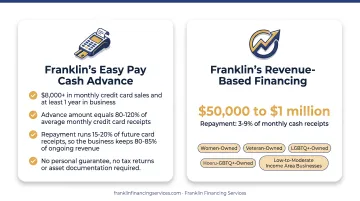
Franklin's Easy Pay Cash Advance structure:
- Requires $8,000+ in monthly credit card sales and at least 1 year in business
- Advance amount equals 80-120% of average monthly credit card receipts
- Repayment runs 15-20% of future card receipts, so the business keeps 80-85% of ongoing revenue
- No personal guarantee, no tax returns or asset documentation required
Franklin's Revenue-Based Financing program offers $50,000 to $1 million with repayment at 3-9% of monthly cash receipts, specifically built for women-owned, veteran-owned, LGBTQ+-owned, and low-to-moderate income area businesses.
How to Qualify for Bar Business Financing
Lenders evaluating a bar loan application typically look at four things:
- Time in business — often 6 months to 1 year minimum, depending on the product
- Monthly revenue — consistent deposits and card processing volume matter more than a single strong month
- Credit score — important, but not the only factor considered
- Liquor license and business registration — proof the establishment is legally operating
Where Alternative Lenders Differ From Banks
Traditional banks lean heavily on personal credit score. Alternative lenders like Franklin Financing Services weigh cash flow more heavily, which opens doors for owners who've faced poor credit, late payments, or a previous bank turndown.
Here's a quick self-assessment benchmark: if your bar processes $8,000 or more in monthly credit card sales and has been operating for at least a year, you likely qualify. Franklin's Easy Pay Cash Advance considers this threshold regardless of past credit challenges.
Documentation Checklist
Most applications require:
- 3-6 months of bank statements (or the last 4 months for Franklin's Fast Track term loan program)
- Tax returns for the business
- Business licenses, including the liquor license
- A brief business overview describing operations and use of funds
Beyond the standard paperwork, Franklin also runs dedicated programs for women-owned, veteran-owned, LGBTQ+-owned, and start-up businesses, along with companies located in low-to-moderate income areas, recognizing that these owners often face extra friction with conventional lenders.
How Franklin Financing Services Helps Bar Owners Get Funded
Franklin operates as a financing partner with relationships across national lenders, built specifically for businesses that don't fit neatly into a bank's approval box.
What sets the process apart:
- Speed: approvals in as little as 24-48 hours on certain programs, with funding arriving in 3-7 days
- Flexible repayment: tied to revenue or credit card receipts rather than a rigid fixed payment
- No personal guarantee: waived entirely on select programs like Easy Pay Cash Advance**
- SBA Preferred status: accelerates processing for bar owners pursuing 7(a) financing
Franklin's certified financial professionals also help owners consolidate multiple high-cost loans into a single, lower payment. This frees up cash that would otherwise go toward servicing separate debts each month.
For a bar juggling an equipment loan, a merchant cash advance, and a term loan at once, that restructuring can mean the difference between breaking even and turning a profit.
Bar Financing vs. Traditional Bank Loans: Which Is Right for You
Approval odds and speed vary widely by lender type. According to the Federal Reserve's small business credit research, finance companies approved at least some financing for 76% of applicants and small banks for 75%. Online lenders approved 70%, while large banks approved just 66%.
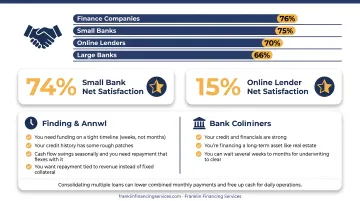
Satisfaction told a different story: small banks scored a 74% net satisfaction rating, compared to just 15% for online lenders, suggesting speed and satisfaction don't always move together.
Alternative financing tends to fit better when:
- You need funding on a tight timeline (weeks, not months)
- Your credit history has some rough patches
- Cash flow swings seasonally and you need repayment that flexes with it
- You want repayment tied to revenue instead of fixed collateral
Bank or SBA loans make more sense when:
- Your credit and financials are strong
- You're financing a long-term asset like real estate
- You can wait several weeks to months for underwriting to clear
For bars carrying multiple loans at once, debt consolidation is worth a serious look either way. Restructuring through a partner like Franklin Financing Services can lower combined monthly payments and put real cash back into daily operations instead of debt service.
Frequently Asked Questions
What is bar financing?
Bar financing is capital used to open, renovate, expand, or sustain a bar's operations. It's available through SBA loans, term loans, equipment financing, and alternative lenders.
What credit score do I need to get a bar loan?
Alternative lenders often weigh cash flow and revenue more heavily than credit score, making them accessible to owners with credit challenges. Banks and SBA programs typically prefer stronger profiles, though no universal minimum score applies.
Can I get financing to open a new bar with no prior experience?
Startup financing is harder to secure without an operating history, but it's possible through equipment financing, SBA microloans, or alternative lenders. A strong personal credit history and solid business plan improve your odds.
How fast can I get approved and funded for bar financing?
Alternative lenders can approve and fund certain programs in 24-48 hours to about a week. The SBA 7(a) loan program typically takes 5-10 business days for a credit decision, with total funding taking longer once underwriting and closing wrap up.
Do I need collateral or a personal guarantee for bar business loans?
Requirements vary by product. Equipment financing uses the equipment itself as collateral, while some alternative programs, like Franklin's Easy Pay Cash Advance, require no personal guarantee at all.
What documents are needed to apply for bar business financing?
Most applications require several months of bank statements, business licenses including your liquor license, tax returns, and a brief overview of the business and how funds will be used.