Rates on business equipment loans and leases span an enormous range right now, roughly 4% to 45% APR, depending on where a business falls on the credit and risk spectrum. Most healthy, established businesses land somewhere between 6% and 25%, with credit-challenged borrowers pushing toward the top of that range.
There's no fixed sticker price here. Your rate depends on your credit profile, how long you've been in business, what kind of equipment you're financing, and how the deal is structured. Two businesses buying identical machines can walk away with quotes several points apart.
This article breaks down current rate ranges by lender type, the factors that push your rate up or down, and how a partner like Franklin Financing Services helps businesses, including those already turned down by a bank, find a workable rate.
Key Takeaways
- Bank and SBA loans start near 6% for strong-credit borrowers; alternative lenders can exceed 25% for weaker profiles
- Credit score, time in business, equipment age, and loan term all affect your rate
- A bank turndown doesn't close the door, it shifts you to a different lender type and rate tier
- Comparing quotes and refinancing existing debt can sharply lower your total borrowing cost
Business Equipment Financing Rates: What to Expect Right Now
Equipment financing rates aren't posted on a rate sheet the way a mortgage rate might be. Each deal gets underwritten individually, based on your business and the collateral behind it. That's why shopping on interest rate alone is a common mistake.
A slightly higher rate with faster approval, lower fees, and no personal guarantee can cost less overall than a "cheaper" loan buried in add-on fees or stretched across a two-month underwriting process.
Bank and Credit Union Financing
Banks and credit unions typically offer the most competitive pricing available, often landing in the 6%-9% range for well-qualified, established businesses. To get there, you generally need:
- Two or more years in business
- Strong personal and business credit
- Consistent revenue and clean financial statements
The tradeoff: approval can take several weeks, and documentation requirements are strict. If your business doesn't check every box, a bank often isn't the fastest or most realistic path.
SBA-Backed Equipment Financing
SBA 7(a) loans cap rates at a base rate, commonly prime, plus a spread that shrinks as the loan amount grows:
| Loan Amount | Maximum Spread Above Base Rate |
|---|---|
| $50,000 or less | 6.5% |
| $50,001–$250,000 | 6.0% |
| $250,001–$350,000 | 4.5% |
| Above $350,000 | 3.0% |
Source: SBA 7(a) terms, conditions and eligibility
With prime hovering in the high single digits, that puts many SBA-backed equipment loans somewhere in the 10%-14% range, though lenders often price below the ceiling for stronger borrowers.
Speed is where SBA programs typically struggle. Franklin Financing Services holds a Preferred Financial Services designation from SBA lenders, which usually speeds up processing on a program that otherwise moves slowly.
Alternative and Non-Bank Lenders
Businesses with marginal credit, recent late payments, or a bank turndown on their record usually land here, generally in the 15%-25%+ range. The higher price reflects the added risk the lender absorbs, not a penalty for asking.
The upside is speed. Approvals and funding are often available within days rather than weeks, and credit requirements flex much further than a bank's.
Equipment Leasing Arrangements
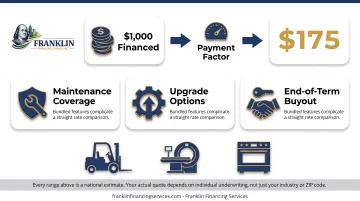
Lenders usually quote leases as a payment factor (a monthly payment per $1,000 financed) rather than a stated interest rate. That figure can bundle in maintenance coverage, upgrade options, or an end-of-term buyout, which makes a straight rate comparison tricky.
Every range above is a national estimate. Your actual quote depends on individual underwriting, not just your industry or ZIP code.
Key Factors That Affect Your Equipment Financing Rate
Every rate you're quoted reflects how much risk the lender thinks they're taking on. Strong credit, steady revenue, and easy-to-resell equipment read as low risk and price accordingly.
Credit History (Business and Personal)
Both your business credit profile and your personal score matter, especially for smaller companies where a personal guarantee is often required. A 600 credit score is a common minimum for equipment financing, but that's a floor, not a rate.
Stronger scores move you toward the bank and SBA end of the spectrum. Limited or challenged credit usually means a higher rate, not an automatic decline.
Time in Business and Revenue Consistency
Banks typically want at least two years in business and consistent, verifiable revenue before offering their best pricing. Steady, multi-year revenue reads as predictable and low-risk. Newer businesses aren't shut out, but they should expect a few extra percentage points until they've built a track record lenders can underwrite against.
Equipment Type, Age, and Resale Value
New equipment with strong resale value, think vehicles or medical equipment, tends to price better because the lender has solid collateral if things go wrong. Older or highly specialized machinery with a narrow buyer pool usually carries a higher rate and may require an appraisal.
Used equipment often faces a 10-year age cap, with terms that can't exceed the asset's remaining useful life.
Loan Term and Financing Amount
Shorter terms generally earn lower rates since the lender's money is at risk for less time. Larger financing amounts can sometimes earn better pricing, per SBA's own sliding spread scale, but they also demand heavier documentation. Most equipment loans run 3 to 10 years, typically matched to the asset's expected useful life.
Down Payment
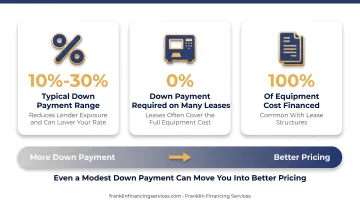
Putting money down, commonly 10%-30%, reduces the lender's exposure and can shave real points off your rate. Plenty of programs finance equipment with no down payment at all, particularly leases, which often cover 100% of the equipment cost. If cash flow allows, even a modest down payment can move you into better pricing.
Fixed Rate vs. Variable Rate, and Loan vs. Lease
How your financing is structured changes how the "rate" shows up in your monthly payment, not just the number itself. Two businesses financing similar equipment at comparable pricing can end up with very different budgeting experiences depending on the structure they choose.
Fixed vs. Variable Rate Financing
Most equipment loans and leases use a fixed rate for the full term, unlike a business line of credit, which typically floats with prime. That predictability matters: your payment in month one looks the same as your payment in year four, making cash flow planning far easier.
Some commercial banks do offer floating-rate equipment financing, so confirm which structure you're being quoted before you sign. If rates fall during your term, a variable structure could save money; if they rise, a fixed rate protects you. That same trade-off between certainty and flexibility carries into your next decision: loan or lease.
Equipment Loans vs. Equipment Leases
An equipment loan carries a straightforward interest rate, while an equipment lease bundles cost into one predictable payment. Down payment requirements and ideal use cases differ:
| Structure | Down Payment | Best For |
|---|---|---|
| Loan | Usually required | Long-lasting equipment you'll own outright, like vehicles or industrial machinery |
| Lease | Often none | Fast-depreciating assets like IT hardware you'll want to upgrade every few years |
Because a lease shifts obsolescence risk onto the leasing company, it beats owning gear nobody wants to buy back. Franklin Financing Services structures both loan and lease programs, matching the payment type to how long your equipment actually holds value.
How to Position Your Business for a Better Rate
Your credit score isn't the only lever you can pull. Preparation and choosing the right lender for your situation matter just as much.
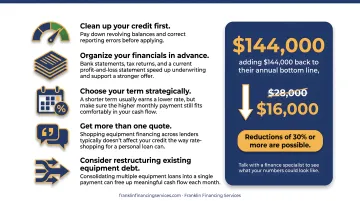
- Clean up your credit first. Pay down revolving balances and correct reporting errors before applying. Even a modest score bump can shift you into a better pricing tier.
- Organize your financials in advance. Bank statements, tax returns, and a current profit-and-loss statement speed up underwriting and support a stronger offer.
- Choose your term strategically. A shorter term usually earns a lower rate, but make sure the higher monthly payment still fits comfortably in your cash flow.
- Get more than one quote. Shopping equipment financing across lenders typically doesn't affect your credit the way rate-shopping for a personal loan can.
- Consider restructuring existing equipment debt. Consolidating multiple equipment loans into a single payment can free up meaningful cash flow each month.
Franklin Financing Services works with a network of national lenders to restructure existing equipment debt, even for businesses a bank previously declined. Reductions of 30% or more are possible.
One manufacturer consolidated $28,000 in monthly payments across several equipment loans into a single $16,000 payment, adding $144,000 back to their annual bottom line. Talk with a finance specialist to see what your numbers could look like.
What Business Owners Often Get Wrong About Equipment Financing Rates
- Fixating on the headline rate. A "low" 7% quote with origination fees and a personal guarantee can cost more than a 9% offer without them. Compare total cost, not just the percentage.
- Assuming bad credit or a bank turndown ends the conversation. It just moves you from bank pricing to alternative-lender pricing, still financeable, just at a different rate.
- Overlooking the tax side. The Section 179 deduction lets you deduct up to $2,500,000 of equipment cost in 2025, lowering your effective, after-tax rate below the stated one.
Frequently Asked Questions
What is the average interest rate on equipment financing?
Rates typically run from about 6% for bank and SBA financing with strong credit up to 25% or more through alternative lenders. Your equipment type and credit profile determine where in that range you'll fall.
What is the monthly payment on a $50,000 business loan?
Payment depends heavily on your rate and term: at 7% over 5 years, expect roughly $990 a month, versus about $1,190 at 15%. Use an equipment loan calculator for an exact figure once you have a real quote.
Is 7% a good loan rate?
Yes, a 7% rate is strong and typical of bank or SBA financing for well-qualified borrowers. Alternative financing for businesses with credit challenges usually runs meaningfully higher.
Can you get equipment financing with bad credit or after a bank turndown?
Yes. Alternative lenders and financing brokers regularly work with businesses banks decline, typically at a higher rate that offsets the added risk. A turndown shifts your options; it doesn't eliminate them.
Do you need a down payment for equipment financing?
Many programs, especially leases, require none at all. A down payment isn't mandatory, but putting money down can improve your pricing when your budget allows for it.
How fast can you get approved for equipment financing?
Certain programs issue approvals within 24-48 hours, with funding following in as little as 3-7 days. Timelines vary by lender and how quickly you provide documentation.