

Healthcare financing works differently than a standard small business loan. Lenders look at your licensure, your patient revenue cycle, and the relative stability of your specialty before they look at anything else. That changes what "qualifying" actually means.
This guide breaks down the loan types available, what lenders require, and how to secure financing even if a bank has already turned you down.
Key Takeaways
- Medical practice loans match healthcare cash flow cycles, often beating generic business loan terms
- Options include term loans, SBA loans, equipment financing, credit lines, and working capital
- Poor credit or bank denials don't block financing through Franklin Financing Services
- Solid documentation, including financial statements and a clear use of funds, improves approval odds
What Are Medical Practice Loans and Why They're Different
Medical practice loans are financing products built for physicians, dentists, chiropractors, and other licensed healthcare providers who need capital to start, run, or grow a practice. They cover the same broad categories as general small business loans, but the underwriting process accounts for factors unique to healthcare.
Standard business underwriting weighs credit score and revenue history. Medical practice underwriting adds:
- Professional licensure and years in active practice
- Predictability of patient demand within the specialty
- Debt-service coverage and payer mix stability
- Historical and projected cash flow patterns
Once a lender weighs these factors and approves a loan, practices put the funds toward several areas:
- Purchasing diagnostic equipment, such as MRI or X-ray machines
- Renovating or expanding facility space
- Hiring clinical and administrative staff
- Bridging cash flow gaps caused by delayed insurance reimbursements
Healthcare businesses are frequently viewed as lower-risk borrowers because patient demand tends to stay steady even during economic downturns. That perception can translate into more favorable rates and faster approvals compared to other industries.
That said, plenty of practices still get turned down. Newer providers with limited credit history, lingering medical school debt, or inconsistent early-year revenue often struggle at traditional banks, even when their long-term outlook is strong. That gap is exactly where alternative financing becomes relevant, a topic we'll return to later in this guide.
Types of Medical Practice Financing
There's no single "best" loan for medical practices. The right fit depends on what you're financing, how quickly you need funds, and how your practice's finances currently look.
Term Loans
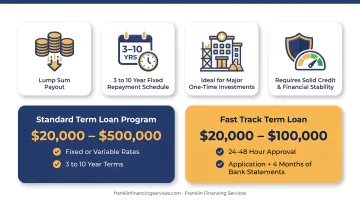
Term loans provide a lump sum repaid on a fixed schedule, typically over 3 to 10 years. They work well for large, one-time investments like opening a new clinic location or completing a major renovation.
Approval generally requires solid credit and financial stability. Rates can be fixed or variable depending on the lender. Franklin Financing Services offers a Standard Term Loan Program ranging from $20,000 to $500,000, plus a Fast Track option for $20,000 to $100,000 that approves in 24-48 hours with just an application and four months of bank statements.
SBA Loans (7(a) and 504 Programs)
SBA-backed loans offer competitive rates and extended repayment terms for working capital, practice acquisitions, or real estate purchases.
- 7(a) loans go up to $5 million, covering working capital, real estate, equipment, and debt refinancing
- 504 loans go up to $5.5 million with 10, 20, or 25-year terms, though funds can't be used for working capital or inventory
The tradeoff is paperwork. SBA loans involve more documentation and longer timelines than a conventional term loan. Franklin Financing Services' designation as a Preferred Financial Services company by SBA lenders helps offset that, allowing loans to move through underwriting faster than they would with a non-preferred lender.
Equipment Financing
Equipment financing uses the purchased equipment itself as collateral, letting practices acquire imaging systems, diagnostic tools, or treatment machines without draining cash reserves. 70% of healthcare end users used financing for equipment and software acquisitions in 2023, according to industry data from the Equipment Leasing and Finance Foundation's 2024 Horizon Report.
Financing versus leasing comes down to intent:
- Financing builds ownership equity over time, better for equipment with a long useful life
- Leasing suits fast-depreciating technology where you'll want to upgrade in a few years
Business Lines of Credit
A line of credit gives you revolving access to funds, and you only pay interest on what you draw. This structure fits practices managing seasonal billing swings or unpredictable reimbursement timing, since you're not locked into a fixed repayment amount every month regardless of cash position.
Commercial Real Estate Loans
These loans fund the purchase, construction, or refinancing of clinic space. Terms run long, often matching the 25-year maximums available through SBA 7(a) or 504 programs, which makes sense for practices with an established patient base and predictable revenue.
Working Capital & Alternative Financing Solutions
Working capital loans and merchant cash advances address short-term needs like payroll or bridging a reimbursement delay. They're not designed for major capital projects, but they solve the immediate problem of keeping the lights on.
For practices facing a bank turndown, credit challenges, or an urgent timeline, Franklin Financing Services' Easy Pay Cash Advance program offers a fast alternative. It requires $8,000 or more in monthly credit card sales and no financial documentation, with approvals in 48 hours and funding in under 7 days. Advances run 80-120% of average monthly receipts, up to $150,000.
How to Qualify and Apply for a Medical Practice Loan
Lenders evaluating a medical practice loan application typically look at four core factors:
- Personal and business credit score - both matter, especially for newer practices
- Practice revenue - consistency counts more than raw size
- Existing debt levels - your debt-to-income ratio signals repayment capacity
- Years in operation - longer histories generally mean easier approvals
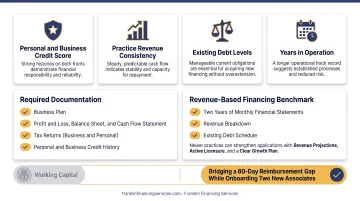
Required documentation usually includes:
- A business plan outlining how funds will be used
- Financial statements: profit and loss, balance sheet, and cash flow statement
- Tax returns (business and often personal)
- Personal and business credit history
For example, lenders that Franklin Financing Services works with for revenue-based financing typically require two years of monthly financial statements, a revenue breakdown, and an existing debt schedule - a useful benchmark for what most lenders will ask.
Beyond the paperwork, lenders want to see consistent revenue and profitability, a manageable debt load, and a use of funds that's specific rather than vague. "Working capital" is weaker on an application than "bridging a 60-day reimbursement gap while onboarding two new associates."
Newer practices without long financial track records can still build a strong case. Detailed revenue projections, proof of active licensure, and a clear growth plan often carry more weight than raw time-in-business when the lender understands the underlying demand for your services.
Weighing the Pros and Cons of Medical Practice Financing
Financing opens doors, but it's not without friction.
Benefits:
- Access to capital for equipment, staffing, or expansion without draining reserves
- Some programs offer interest-only or flexible payment structures
- Preserves cash for day-to-day operations rather than tying it up in a single purchase
Drawbacks:
- Traditional bank applications can take weeks and demand extensive documentation
- Approval standards at banks remain strict, particularly for newer or lower-revenue practices
- Some loan structures carry long repayment timelines that limit future flexibility
The gap between these two lists is real. Among small business borrowers with medium or high credit risk, a Federal Reserve study found approval rates of 76% at online lenders compared to just 34% at large banks.
That disparity is why so many practices end up exploring non-bank lenders once a traditional application stalls or gets declined.
Why Franklin Financing Services for Medical Practice Funding
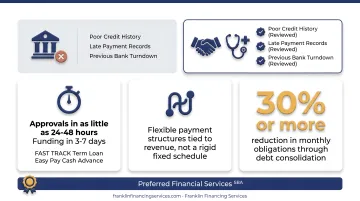
Most banks only extend financing to the most credit-worthy applicants. Franklin Financing Services takes a different approach, working with practices facing poor credit, late payments, or a previous bank turndown.
What that looks like in practice:
- Approvals in as little as 24-48 hours for select programs, including the FAST TRACK Term Loan
- Funding in 3-7 days through options like the FAST TRACK Term Loan and Easy Pay Cash Advance
- Flexible payment structures tied to revenue rather than a rigid fixed schedule
- Debt consolidation options that restructure existing equipment loans into a single payment, reducing monthly obligations by 30% or more in documented cases
That last point matters more than it might seem. A practice juggling multiple equipment loans, each with its own rate and schedule, often has unrealized equity sitting in that equipment. Consolidating those loans into one can free up meaningful monthly cash flow without touching new debt at all.
Beyond debt consolidation, Franklin Financing Services' Preferred Financial Services designation with SBA lenders speeds up loan processing in a different way. SBA applications move through underwriting faster than they would with a standard lender, and partnerships with national lenders expand what's actually available to a given practice.
Frequently Asked Questions
What is the monthly payment on a $50,000 business loan?
It depends on the term, rate, and loan type. For example, a $50,000 loan at 10% over 60 months runs about $1,062 per month, excluding fees. Get a personalized quote for exact figures based on your credit and revenue profile.
What are the two main types of financing?
The two broad categories are debt financing (loans and credit lines repaid over time with interest) and equity financing (raising capital by selling ownership stake). Most medical practice loans fall under debt financing.
How much can I typically borrow for a medical practice loan?
Loan amounts typically range from $20,000 for working capital needs up to $5 million for real estate purchases or practice acquisitions, with SBA loans often falling between $150,000 and $5 million. Your revenue and creditworthiness determine where you land within that range.
Can I get a medical practice loan with bad credit?
Banks often decline applicants with low credit scores, but alternative lenders like Franklin Financing Services evaluate revenue and cash flow rather than relying on credit score alone.
How fast can medical practice loans be funded?
Alternative lenders can fund in as little as a few days, sometimes within 3-7 days. SBA or traditional bank loans typically take several weeks due to added documentation and review steps.
Do medical practice loans require collateral or a personal guarantee?
The asset itself, such as equipment, often secures loans like equipment financing. Some alternative financing programs, such as certain cash advance products, don't require a personal guarantee at all.